
Voltage, frequency, and plug type are often different in other parts of the world. Physical compatibility of receptacles does not guarantee voltage, frequency, or connection to earth (ground) compatibility, including plugs and cords. Older standards may still exist in some regions. For this reason, it is important to be aware of the differences, particularly if your product relies on electricity.
This page provides a comprehensive global guide to mains electricity standards, detailing the specific plug types, nominal voltages, and frequencies used in different nations. Fifteen primary domestic power connectors, from Type A to Type O are categorised, while highlighting how historical engineering rivalries led to the divide between 50 Hz and 60 Hz systems. Travellers and professionals can use these references to identify where grounded or ungrounded sockets are standard and which regions require voltage converters or adapters. Additionally, the technical differences between single-phase residential power and three-phase industrial supplies are explained as well as the safety concerns regarding universal outlets.
The global landscape of mains electricity is defined by significant variations in nominal supply voltage, AC frequency, and the physical design of plugs and sockets. While the majority of the world utilizes a mains supply between 220 and 240 volts at a frequency of 50 or 60 Hz, a smaller number of countries, primarily in North America, operate on 100–127 volts. These differences mean that travellers must often rely on adapters or transformers to ensure their devices function safely abroad.
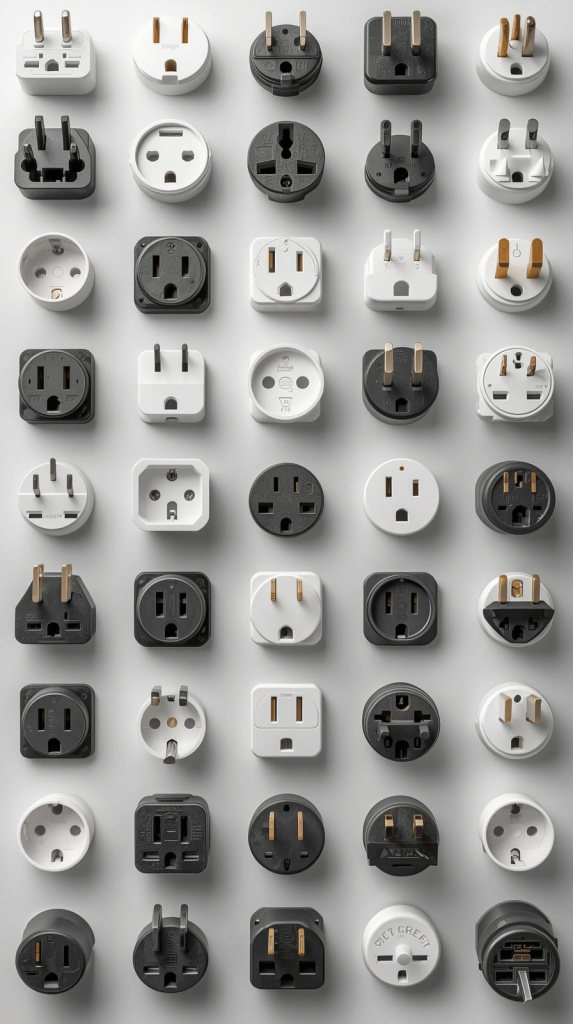
Voltage and Frequency Standards
The International Electrotechnical Commission (IEC) standard 60038 aims to harmonise global voltages to 230/400 V (single-phase/three-phase), though older standards like 220/380 V and 240/415 V persist in many regions.
- Voltage: Countries with lower voltages (around 120 V) often lack high-power domestic appliances, such as electric kettles, because their outlets (typically 15 A) cannot provide the necessary wattage as efficiently as the 230 V systems found in Europe.
- Frequency: The global split between 50 Hz and 60 Hz is a relic of 19th-century engineering rivalries. German companies like AEG favored 50 Hz as a “sweet spot” for efficiency with the steam engines of the time. Conversely, American engineers at Westinghouse championed 60 Hz because it allowed for smaller, lighter transformers and aligned with the 60-second clock.
Technical and Safety Considerations
Electrical systems are categorized as single-phase, primarily for residential use, or three-phase, which provides stable, heavy-duty power for industrial applications.
- North American Split-Phase: Unlike most of the world, North American premises often use a unique split-phase connection that provides 120 V for standard outlets and 240 V for high-requirement appliances like clothes dryers.
- Universal Sockets: Many regions install “universal” wall sockets that accept various plug shapes. However, these are frequently deemed non-compliant and unsafe because they may fail to establish a proper ground (earth) connection.
- Compatibility Risks: Physical compatibility (a plug fitting into a socket) does not guarantee electrical compatibility. Using a device with the wrong voltage or frequency can cause permanent damage or fire.
Travellers are advised to consult country-specific lists where complex electrical situations are highlighted. By being aware of differences in voltages and plugs, travellers can determine the exact adapter or transformer requirements for their journey.
The 15 Types of Plugs and Sockets
There are currently 15 styles of domestic electrical plugs, arbitrarily assigned letters A through O by the US Department of Commerce.
- Type A & B: Predominantly used in the USA, Canada, Mexico, and Japan, these operate at 100–127 V. Type A is ungrounded with two pins, while Type B adds a third grounding prong. International standards often consider these designs less safe because the prongs are uninsulated and the sockets are not recessed.
- Type C: Known as the “Europlug,” this is a two-pin, ungrounded plug widely used throughout Europe, Asia, and South America.
- Type E & F: Common in continental Europe and Russia; Type E is of French origin, while Type F is the German “Schuko”. Both are 16 A grounded plugs and are largely compatible with one another and Type C plugs.
- Type G: The British standard, featuring three rectangular blades and an internal fuse, used in the UK, Ireland, Malaysia, Singapore, and the Arabian Peninsula.
- Type I: Featuring two or three flat pins in a V-shape, this is the standard for Australia, New Zealand, China, and Argentina.
- Types D & M: Primarily used in India (Type D) and South Africa (Type M), these feature three round pins in a triangular pattern.
- Specialised/Regional Types: Type H is unique to Israel; Type J is exclusive to Switzerland and Liechtenstein; Type K is used in Denmark and Greenland; Type L is found in Italy and Chile; Type N is the standard in Brazil and South Africa; and Type O is used only in Thailand.
Regional Variances for Travellers
While many countries have well-defined standards, several nations in Latin America, Africa, and Asia use a “motley collection” of incompatible plugs. In some instances, voltage can even differ from region to region within the same country.
- Brazil: Uses both 127 V and 220 V depending on the region.
- Japan: Operates at 100 V, but the frequency is split: 50 Hz in Eastern Japan (e.g., Tokyo) and 60 Hz in Western Japan (e.g., Osaka).
- Universal Sockets in Hotels: In countries with varying standards, hotels often provide “hybrid” or universal sockets as a convenience, though safety remains a concern.
Additional links
List of Voltages & Frequencies (Hz) Around the World
The website Generator Source provides a comprehensive chart which includes information on voltages and frequencies around the world.
Country-by-country list of plugs, sockets and voltages
The Worl Standards website provides a full overview of all countries of the world and their respective plugs/outlets and voltages/frequencies used for domestic appliances. The table shows that in most countries the mains supply is between 220 and 240 volts (50 or 60 Hz); countries that operate on 100-127 volts are greatly outnumbered. The list also reveals that types A and C are the most frequently used electric plugs worldwide.
Mains electricity by country
Wikipedia’s page on Mains electricity by country includes a list of countries and territories, with the plugs, voltages and frequencies they commonly use for providing electrical power to low voltage appliances, equipment, and lighting typically found in homes and offices.